
Garage Conversion vs Building a New ADU: Pros and Cons
Key Takeaways
In California and Oregon, many detached garages can be converted to ADUs, but conversion is not always cheaper than building new—especially for structures built before 1990.
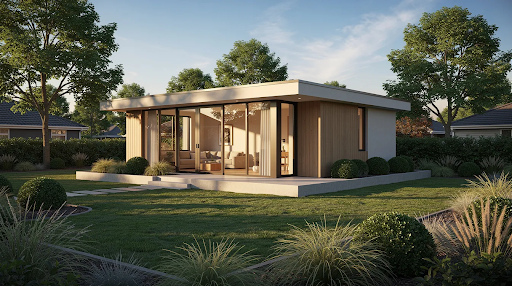
New, detached ADUs (including factory built tiny homes and cottages) usually offer better layouts, comfort, and long-term value than retrofitting an older garage.
Factory built tiny homes from Tiny Home Cottages can often be installed on a new foundation in the backyard while the old garage is removed or repurposed.
The “right” option depends on garage condition, zoning, budget, desired size, and whether you want a modern, detached cottage style home.
Homeowners should get parallel estimates for both conversion and new construction before committing to either path.
Garage Conversion vs ADU: What’s the Actual Difference?
When many homeowners start researching backyard housing options, they quickly encounter two main paths: converting an existing garage into a living space or building a new detached ADU from scratch. Understanding the real differences between these approaches is essential before committing time and money to either option.
A garage conversion ADU reuses an existing garage shell—whether it’s an attached garage or a detached garage—and transforms it into a legal dwelling by adding insulation, plumbing, electrical upgrades, a kitchen, bathroom, sleeping area, and a separate entrance. The goal is to preserve much of the original structure while making it habitable.
A new detached ADU, on the other hand, is a completely independent structure built from the ground up or factory assembled and placed on a new foundation in your backyard space. This could be a site-built unit or a factory built tiny home or cottage designed specifically for living from day one.
Both options must meet minimum habitability standards to qualify as an accessory dwelling unit under current West Coast rules. Post-2020 California ADU laws require a full kitchen, bathroom, sleeping quarters, and independent utilities. Oregon follows similar progressive policies.
An important distinction: attached garage conversions behave more like interior remodels with certain size limitations, while detached ADUs function as independent backyard cottages or tiny homes with greater privacy and separation from the primary residence.
The rest of this article compares cost, timeline, comfort, and long-term value between converting a garage and building a new detached ADU—helping you determine which path makes sense for your property.
Cost Comparison: When Is Conversion Really Cheaper?
The assumption that a garage conversion is always cheaper than new construction is one of the most persistent myths in ADU planning—especially when dealing with older garages built between the 1940s and 1970s.
Real-world data from contractors in San Diego and the Bay Area shows detached garage conversions often landing in the $150,000 to $220,000 range for a 400-500 square foot unit once you account for structural repairs, utility work, and finishes. That’s a far cry from the $50,000 “quick conversion” many homeowners imagine.
Comparable new detached ADUs and factory built tiny homes range from $150,000 to $300,000 depending on size and finishes. Many backyard cottages and tiny homes, excluding site prep, price competitively with complex conversions—sometimes even coming in lower when the existing garage requires extensive rehabilitation.
Main Cost Drivers for Garage Conversions
|
Category |
Typical Cost Range |
Notes |
|
Foundation upgrades |
$10,000–$20,000 |
Slab jacking, edge thickening, new footings |
|
Seismic retrofits |
$15,000–$30,000 |
Required in California for pre-1990 structures |
|
Roof elevation/rebuild |
$25,000+ |
Often needed for adequate headroom |
|
Utility trenching under slab |
$20,000–$40,000 |
Sewer and water line installation |
|
Insulation/energy compliance |
$5,000–$15,000 |
Meeting Title 24 requirements |
Main Cost Drivers for New ADUs
|
Category |
Typical Cost Range |
Notes |
|
New foundation |
$15,000–$30,000 |
Concrete foundation and site prep |
|
Utility trenching |
$20,000–$40,000 |
Water, sewer, electrical connections |
|
Site work/grading |
$10,000–$20,000 |
Preparing the building area |
|
Structure cost |
$100,000–$200,000+ |
More predictable for factory built |
Factory built homes benefit from controlled material purchasing, repeatable processes, and elimination of weather delays. This keeps construction costs and change orders more predictable than a one-off garage remodel where surprises lurk behind every wall.
Rule of thumb: Conversion tends to make sense if the garage is newer (built after approximately 1990), structurally sound, and already close to where utilities enter the property. Otherwise, a new ADU may deliver better value.
Homeowners pursuing a garage conversion project should budget an extra 10-15% contingency for hidden conditions. Rotted framing, sub-code slabs, and termite damage affect 20-30% of older California garages according to pest control industry data. One case study from San Diego showed a 1960s garage conversion ballooning from a $100,000 estimate to $180,000 due to seismic and code issues—approaching the cost of a brand new factory prefab ADU.
Design, Comfort, and Long-Term Livability
Construction costs matter, but the feel of the space for decades matters just as much. A converted garage that saves $30,000 upfront but never feels quite right as a living space is not a bargain over a 20-year time horizon.
Layout Limitations in Garage Conversions
Garages are typically designed as utilitarian boxes—often narrow 20x20 foot footprints with 8-9 foot ceilings. When you try to carve out a functional living space from this existing space, you quickly run into constraints:
Accessible bathrooms require a minimum 5x8 foot area
Full kitchens need roughly 10 linear feet of counter space to meet codes
Storage often gets sacrificed to make room for required features
Fire separation requirements near property lines can consume usable square footage
The result is frequently a cramped studio that loses 10% or more of its area to structural requirements and firewalls.
Purpose-Built ADU Advantages
New detached ADUs and factory built tiny homes are engineered for living from the start. They feature:
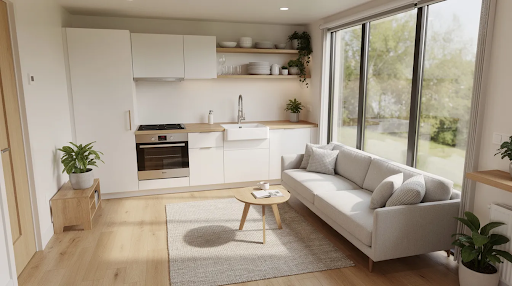
Open floor plans with efficient circulation
Modern 9-foot ceilings (or higher in lofted models)
36-inch hallways for wheelchair accessibility
Strategic window placement for natural light and privacy
Integrated HVAC and insulation designed as a complete system
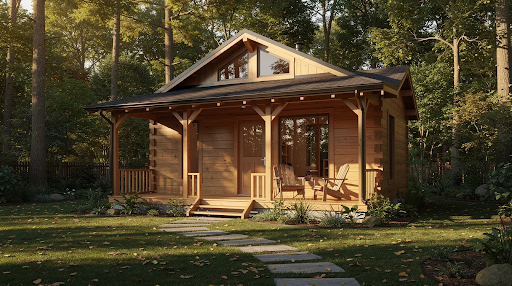
Tiny Home Cottages offers multiple models that can’t be replicated in an old garage shell: single-story tiny homes with modern layouts, lofted units that maximize vertical space with steep roof pitches and stacked windows, and cabin-style cottages with tongue-and-groove pine finishes for rustic appeal.
Thermal Comfort and Energy Costs
The numbers tell a clear story on energy efficiency:
|
Feature |
Garage Conversion |
New Detached ADU |
|
Wall insulation |
R-13 maximum (2x4 walls) |
R-21 typical (2x6 walls) |
|
Attic insulation |
Varies widely |
R-38 standard |
|
Window efficiency |
U-factor ~0.35 (retrofitted) |
U-factor ~0.20 (triple-pane) |
|
HVAC efficiency |
Varies |
SEER 20+ mini-splits |
|
Utility savings |
Baseline |
30-50% lower bills |
New ADUs can be oriented with south-facing windows for passive solar gain and positioned for privacy, achieving 20-30% window area for abundant natural light. Garage conversions inherit fixed orientations and typically manage only 10-15% glazing due to fire separation requirements.
For long-term multigenerational living—housing a parent for 10-20 years, for example—a purpose-built cottage will usually be more comfortable, safer, and easier to navigate than a compromise layout squeezed into an old garage structure.
Permitting, Zoning, and Setbacks in California and Oregon
Both garage conversions and new ADUs must follow local zoning laws, but state laws—especially in California since 2020—have made both options significantly easier. Understanding the permitting process helps you plan realistic timelines and avoid costly surprises.
Setback Advantages for Conversions
Legally built detached garages often qualify for “grandfathered” reduced setbacks when converted. If your detached garage sits just 1-3 feet from the property line (common in older neighborhoods), you may be able to keep that placement as an ADU—a major advantage on tight city lots where current codes would require 4-5 feet.
Tearing a garage down and rebuilding a new detached ADU in the same footprint sometimes allows continued use of those old setbacks, but only if local planning rules permit. San Diego, Portland, and other cities differ in how they handle this situation.
Requirements for New Detached ADUs
New detached ADUs placed elsewhere in the yard typically must meet current side and rear setbacks:
California: Commonly around 4 feet in many cities
Oregon: Similar 4-foot minimums in urban zones
Height caps: Usually 16-18 feet
Lot coverage: Generally under 40%
Maximum size: Often 800-1,200 square feet or 50% of primary home
Timeline Considerations
The permitting process can vary significantly:
Garage conversions may permit faster (2-4 months) if the exterior already exists, but can stall on engineering stamps for seismic retrofits or investigation of unpermitted past work (affecting roughly 20% of pre-1980 California garages)
Factory built tiny homes are built under national building standards and undergo pre-inspection during manufacture, often simplifying certain aspects of local plan review
On-site work for factory built units focuses on foundation, utility connections, and final setup—still requiring local permits but with fewer variables
State laws like California’s AB 1033 (2023) and Oregon’s HB 3166 (2021) mandate ministerial approval for ADUs under 800 square feet with relaxed parking requirements, but local nuances persist. HOAs or historic districts may add hurdles. Check with your local building department or an ADU specialist before investing in design fees.
Pros and Cons of Converting Your Existing Garage
Some garages are genuinely good candidates for conversion. Many older ones, however, hide expensive problems that only emerge after construction begins.
Pros of Garage Conversions
No new footprint: Preserves backyard space and keeps more yard open for other uses
Potential setback advantages: Existing placement may be closer to property line than new construction would allow
Lower foundation cost: If the concrete foundation and footings pass engineering review, you save $40,000-$60,000
Faster permitting: Exterior already exists, potentially shortening initial approval timeline
Cons of Garage Conversions
Unpredictable structural issues: Corroded rebar (common in 1940s coastal California/Oregon due to salt air) can trigger full teardowns
Limited design flexibility: Cannot easily add lofts, change ceiling heights, or reorient the structure
Energy code challenges: Thin 2x4 walls make R-21 insulation impossible; slab-on-grade creates heat loss
Loss of parking and storage space: Many households rely on covered parking for vehicles or unused garage space for equipment
40% cost overrun risk: Hidden defects frequently push budgets well beyond estimates
Common surprises during garage conversion projects include:
Needing to thicken slab edges or add interior footings for load-bearing walls
Complete roof rebuilds to meet snow or wind loads in Oregon or northern California counties
Termite damage affecting structural framing (found in 20-30% of older California garages)
Electrical upgrades and plumbing in conversions are often as expensive as in a new detached ADU because garages rarely have 200-amp service or any wastewater lines. You’re essentially building new systems within an old shell.
Garage conversions work best for homeowners who are happy with a compact studio or small one-bedroom layout that closely matches the existing garage footprint—and whose garage floors, walls, and roof are in good condition.
Pros and Cons of Building a New Detached ADU or Tiny Home Cottage
New detached ADUs—including factory built tiny homes—are generally the best long-term solution for homeowners who want flexible, comfortable, and durable housing on their property.
Pros of New Detached ADUs
Completely new structure: No inherited problems from aging construction
Modern energy-efficient envelope: Purpose-built with R-30+ insulation and advanced HVAC
Full design control: Choose layout, window placement, ceiling height, and finishes
Better accessibility options: Zero-step entries, wider doorways, and ADA-compliant bathrooms are easier to incorporate
Stronger resale story: A “2025 cottage” appraises better than a “converted 1960s garage”
Tiny Home Cottages’ factory built homes are constructed in a controlled indoor environment under national building codes. This approach improves quality control, reduces weather delays, and standardizes inspections. Indoor welding and assembly cut defects by approximately 50% compared to outdoor construction.
Range of Models Available
|
Model Type |
Best For |
Key Features |
|
Single-story tiny homes |
Aging in place, accessibility |
9-foot ceilings, modern layouts |
|
Premium single-story |
Upgraded living |
Cement exterior siding, enhanced finishes |
|
Lofted tiny homes |
Maximizing space |
Second-level loft, steep roof pitch, stacked windows |
|
Cabin series cottages |
Rural/wooded properties |
Tongue-and-groove pine, metal roofing |
|
HUD manufactured homes |
Larger households |
400-1,000 square feet |
Cons of New Detached ADUs
New foundation required: Adds $15,000-$30,000 to project cost
Utility trenching: Water, sewer, and electrical connections to new space
Possible yard loss: The new structure occupies 200-400 square feet
Garage handling: May need to remove or repurpose existing garage if space is tight
Although upfront costs can be similar or slightly higher than a conversion, the long-term benefits in comfort, energy savings, and flexibility often make new detached ADUs more cost-effective over 15-30 years. Higher rental potential ($2,000-$3,000/month for detached units vs. $1,500-$2,200 for conversions in markets like San Diego) further strengthens the investment case.
Factory Built Tiny Homes vs Site-Built ADUs
Both factory built and site-built options qualify as “new ADUs,” but the building process differs dramatically—with significant implications for timeline, cost predictability, and quality.
Site-Built ADU Characteristics
Site-built ADUs are constructed entirely outdoors on your property. This traditional approach involves:
Multiple subcontractors working in sequence
Weather vulnerability causing average 20% delays in California rainy seasons
Frequent change orders adding 15% to budgets
Material waste of 10-15%
Total timelines of 6-12 months
Factory Built Home Advantages
Factory built homes are constructed on an assembly line under consistent controlled conditions:
95% completion indoors before transport
Federal or national inspections during construction
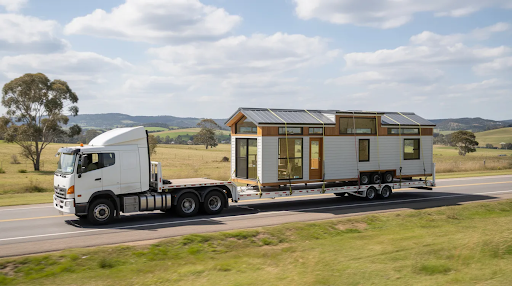
Delivery via specialized transport
On-site work limited to 2-4 weeks for foundation and utility connections
Tiny Home Cottages partners with manufacturers that have decades of experience building small homes and cottages. This expertise produces proven designs with repeatable quality that individual site-built projects struggle to match.
The factory approach is especially appealing in regions with rainy winters like western Oregon or coastal Northern California, where site-built timelines frequently slip 30-50%. When the home arrives nearly complete, you’re not gambling on weather windows.
How to Decide: Key Questions to Ask Before You Commit
Start with your goals. Are you creating housing for family members? Generating rental income? Downsizing? Planning for multigenerational living? Your answer shapes which path makes sense.
Decision Framework Questions
What is the actual condition and age of your garage? A post-1990 garage in good shape is a better conversion candidate than a 1950s structure with questionable foundations.
How much space do you truly need? If 400 square feet works, a compact conversion might suffice. If you need 800 square feet with a guest suite layout, a new ADU offers maximum flexibility.
Do you need a separate yard or patio for the ADU? New placement lets you create dedicated outdoor space; conversions are stuck where the garage sits.
Do you plan to rent it long-term? Tenants staying 10+ years will notice comfort issues that occasional guests might overlook.
Does privacy and access matter? Consider whether guests or tenants need a dedicated path separate from the main house.
Before Committing
Have a contractor or structural engineer assess your garage before assuming it can be easily converted. Cases abound where garages from the 1950s-1960s end up needing almost full reconstruction—defeating the cost advantage entirely.
Get parallel estimates: one for conversion, one for a new backyard cottage or tiny home from a provider like Tiny Home Cottages. Comparing apples-to-apples often reveals that the “cheaper” conversion isn’t actually cheaper.
If long-term flexibility, resale appeal, and comfort are priorities, a new factory built detached ADU is often the wiser investment—even if the upfront number looks similar to a conversion estimate.
Financing Your New Detached ADU or Tiny Home Cottage
Both conversions and new detached ADUs require thoughtful financing planning. The good news is that multiple lending options exist for ADU projects, including specialized products for factory built homes.
Recommended Lending Partners
Tiny Home Cottages often recommends 21st Mortgage Corporation for factory built homes. This lender specializes in manufactured and mobile home loans and has been one of the leading lenders in the industry for many years.
Typical Loan Application Process
|
Step |
What Happens |
|
1. Model Selection |
Choose the home model that fits your needs and budget |
|
2. Application |
Complete a loan application through the lender |
|
3. Approval |
Receive loan approval and review financing terms |
|
4. Rate Lock |
Lock interest rate and submit documentation (ID, income, bank statements) |
|
5. Closing |
Sign closing documents and finalize the loan |
|
6. Funding |
Funds are distributed and home purchase moves forward |
Some qualified buyers may access low or even zero-down options, while others may need higher down payments (10-20%) depending on credit profile and property conditions.
Financial Considerations
Discuss how rental income potential from an ADU might factor into longer-term financial planning
Be careful not to over-leverage based solely on projected rents
Compare financing paths: home equity, cash-out refinance, or specialized manufactured home loans
Work with an advisor who understands ADUs and factory built housing
The financial benefits of adding a rental unit can be substantial, but projections should be conservative and account for vacancy, maintenance, and market fluctuations.
Working with Tiny Home Cottages
Tiny Home Cottages guides homeowners through the entire detached ADU journey—from model selection to factory build and delivery. The company specializes in factory built tiny homes and cottage-style structures constructed under national building code standards.
Home Categories Available
Single-story tiny homes: Entry-level models with modern layouts and approximately 9-foot ceilings
Premium single-story: Upgraded features, modern floor plans, cement exterior siding
Lofted tiny homes: Second-level loft, steep roof pitches, large stacked windows
Cabin series cottages: Natural finishes including tongue-and-groove pine, metal roofing, fiber cement siding
HUD manufactured homes: Larger homes ranging from approximately 400 to 1,000 square feet
All homes are built to national building standards with consistent quality control, then transported to the homeowner’s site for installation on a permanent or semi-permanent foundation depending on local rules.
Common Use Cases
Backyard homes for aging parents
Private cottages for adult children
Guest houses for visitors
Primary residences for downsizing homeowners
Rental units for supplemental income
Many projects start with homeowners who assumed they’d convert their garage—only to realize a new factory built cottage delivers better comfort, value, and flexibility for a similar investment.
Explore model galleries, floor plans, and completed projects to see how a detached cottage can perform better than a cramped garage conversion. Contact Tiny Home Cottages to discuss whether a garage conversion or a new factory built ADU is the better fit for your specific property and budget.
Frequently Asked Questions
Is a garage conversion ADU allowed on every residential lot?
Most residential zones in California and Oregon now allow at least one accessory dwelling unit ADU, but specific rules for converting a detached garage vary by city and county. The garage typically must have been legally built with permits—unpermitted or substandard structures may require partial or full rebuilding before the conversion process is approved.
Verify zoning, lot coverage, and any HOA restrictions with your local planning department before investing in design fees. Some jurisdictions have additional local ADU requirements regarding fire separation, parking requirements, or maximum size that affect whether your particular garage structure qualifies.
Can I keep my garage for parking and still add a detached ADU?
Yes, in many cities you can retain the existing garage and add a new detached ADU elsewhere in the available space of your yard, provided you meet setback, size, and lot coverage limits. This approach lets you maintain your parking space and storage space while still adding extra living space to your property.
State laws in California often prevent cities from requiring replacement parking if you convert a garage, but local nuances exist. Homeowners who rely on covered parking or large storage areas should explore adding a detached ADU rather than sacrificing the garage.
How long does it take to install a factory built tiny home compared to a garage conversion?
Once permits and foundation work are ready, factory built tiny homes can typically be delivered and set within days, with final utility connections and finishing touches taking a few additional weeks. Total on-site time is often measured in weeks rather than months.
Contrast this with many garage conversion projects, which may run 4-8 months from start of construction due to structural work, inspections, and unforeseen repairs. Total project timelines still depend on local permitting backlogs, utility coordination, and site complexity, but factory built homes offer more predictable schedules—especially in regions with unpredictable weather.
Will a new detached ADU or tiny home add more value to my property than a garage conversion?
Appraisers and buyers often favor purpose-built, modern detached units with clear documentation and recent construction dates. Studies suggest new ADUs can add $150,000-$250,000 in increased property value, compared to roughly $100,000 for conversions.
While both conversions and new ADUs can provide increased property value and rental income, a well-designed factory built cottage may be easier to market than a heavily modified 60-year-old garage. Actual value impact depends on local market demand, rental rates, and how well the ADU integrates with the property.
Can I live in a tiny home cottage as my primary residence and rent out my main house?
In many jurisdictions you can occupy the detached ADU yourself while renting the main house, as long as both units meet local building codes and any owner-occupancy rules that apply. This arrangement appeals to homeowners who want to downsize while generating rental income from their larger primary residence.
Some cities have relaxed owner-occupancy requirements for ADUs since 2020, while others maintain restrictions—and rules change frequently. Verify primary residence and rental regulations locally if you plan to downsize into a tiny home and use the main house as an income property. Many homeowners find this approach provides both a cost effective living arrangement and meaningful monthly income.