
Prefab ADUs for Sale Near You: A Smarter Way to Add Housing

Prefab ADUs have changed how California and Oregon homeowners think about adding housing on their property. Instead of waiting a year or more for a site built project to wrap up, they can order a factory built home, have the site prepared in parallel, and move in within a much shorter window. The combination of speed, predictable cost, and consistent quality is why this category continues to grow.
This guide walks through what prefab really means, the timeline and quality benefits, how delivery and placement work, financing options for prefab ADUs, and how to choose the right builder near you.
What prefab really means
Prefab is short for prefabricated. A prefab ADU is built in a factory rather than on your property. The structure is constructed indoors under controlled conditions using consistent crews, controlled materials, and continuous inspection. When complete, the home is trucked to the lot, set in place on a prepared pad, leveled, anchored, and connected to utilities.
Prefab covers several specific construction methods. Some prefab homes arrive fully built and ready to set. Others arrive in modules that get assembled on the property. Tiny Home Cottages focuses on factory built tiny homes and cottage style structures that ship as complete units, ready for placement and connection.
The factory build process matters because it controls the variables that drive timeline and quality. Walls are framed indoors. Materials stay dry. Inspections happen at every stage. The result is a home that arrives consistent with what was specified, on a known schedule, with quality that matches the brochure rather than diverging from it.
Timeline and quality benefits
The timeline benefits of prefab show up at every stage of the project. Design happens once, not as a custom one-off. Permitting often moves faster because the factory built unit comes with documentation that meets recognized standards. Production runs on a known schedule. Site prep happens in parallel with the factory build, so the two streams converge at delivery. Set and connection happen quickly because the home arrives ready.
The quality benefits are equally tangible. A factory environment supports tighter tolerances than a site build. The same crews assemble the same components every day. Materials are protected from weather during construction. Inspections happen continuously, not just at city or county milestones. The walls are square, the doors and windows operate smoothly, the trim lines are clean, and the finishes are consistent.
For buyers comparing options, the difference shows up most clearly after the home is built. A site built ADU sometimes needs corrective work in the first few months because issues that were not caught during construction become visible once the home is in use. A factory built prefab ADU usually does not need that corrective work because the issues were caught during the build itself.
Delivery and placement
Delivery and placement on a prefab ADU follow a clear sequence. The home is loaded at the factory and secured for transport. A truck and trailer carry the unit to your property. Depending on the size of the home and the access on your lot, a crane may be used to position it on the prepared pad. The crew sets the home, levels it, anchors it, and makes the basic connections to utilities.
Site prep needs to be ready before delivery. The pad needs to be level, properly sized for the model you chose, and ready to receive the unit. Utility stub-outs need to be in place where the home will receive them. Trees, fences, and overhead wires need to be cleared from the access path so the truck can reach the placement spot.
Most California and Oregon residential lots can accommodate a prefab ADU with reasonable site prep. The lots that take more planning have steep slopes, narrow access from the street, mature trees in the path, or restricted side yards. A site review with the builder before ordering identifies any issues early so they can be planned around.
Financing your prefab ADU
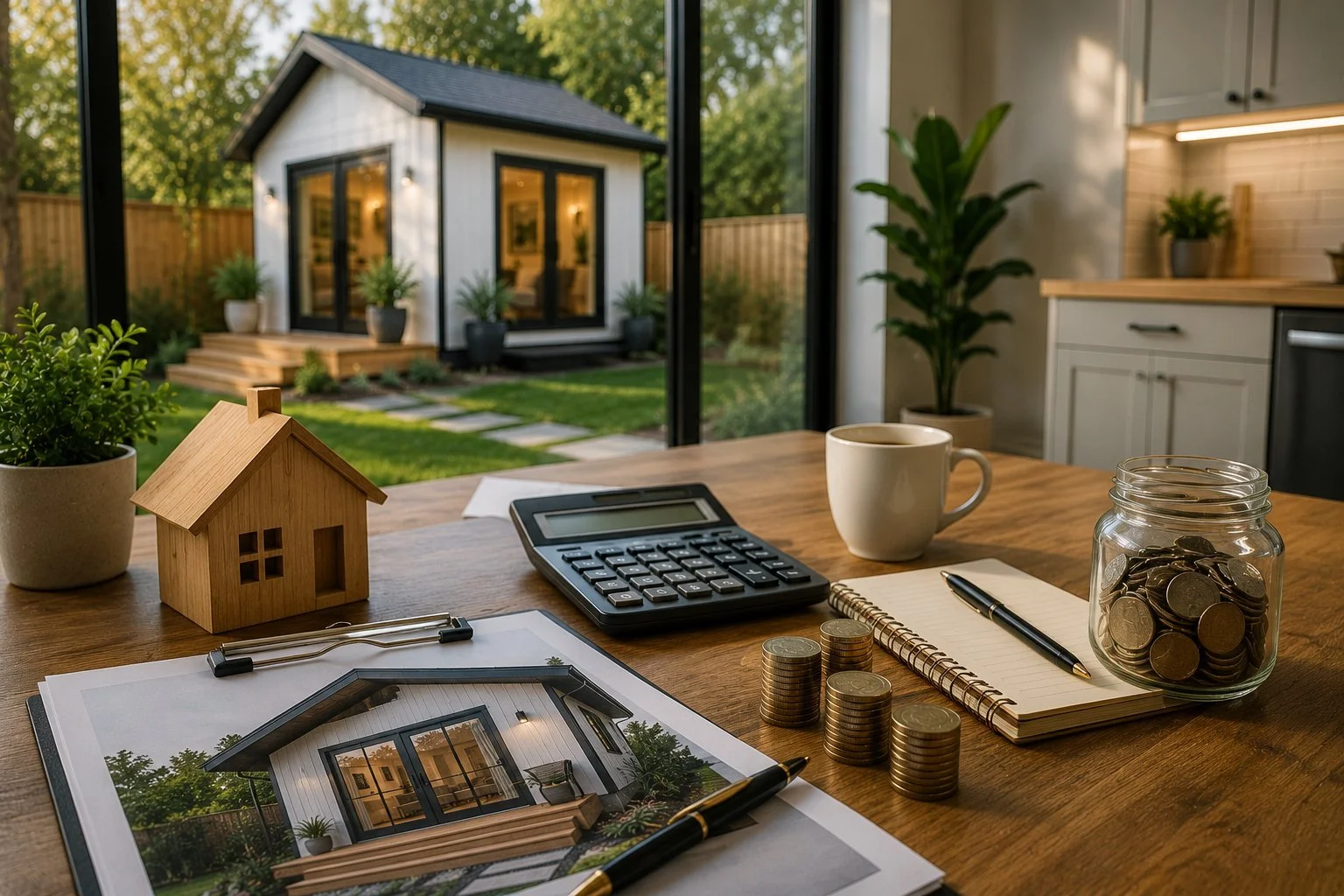
Most buyers finance a prefab ADU. The financing path is more familiar to lenders than custom site built ADUs because the factory built category has been around long enough to develop established loan products. Tiny Home Cottages often recommends 21st Mortgage Corporation, which specializes in manufactured and mobile home loans and has been one of the leading lenders in the industry for many years.
Down payment options range from zero percent for highly qualified buyers to higher percentages depending on credit profile and property conditions. The application moves through a clear sequence. You pick the home model that fits your needs and budget. You complete a loan application through the lender. You receive loan approval and review the financing terms. You lock the interest rate and submit identification, income verification, and bank statements. You sign closing documents and finalize the loan. Once everything is signed, funds are distributed and the home purchase process moves forward.
Knowing the financing path before you fall in love with a model keeps the budget grounded. Pre-qualifying early sets a realistic ceiling on your search and lets you focus on the models that work for your situation.
Choosing a builder near you
The builder behind the prefab home matters as much as the model itself. A few specific questions help you separate serious operators from the rest. Ask how long the manufacturer has been building. Ask what standards the home is built to. Ask how their quality assurance process works. Ask what is included in the delivered price. Ask how they handle warranty and service after delivery.
Tiny Home Cottages partners with manufacturers that have decades of experience producing small homes and cottage style dwellings. That experience shows up in the finished product, in the warranty, and in the way the homes hold up over time. Working with a builder that has a real track record reduces risk on a major housing purchase.
Local presence in delivery matters too. A builder that has delivered to your area knows the typical permit process, the access patterns common in your neighborhoods, and the contractors who can handle site prep. That local familiarity speeds the project and reduces friction.
Common prefab ADU use cases
Prefab ADUs serve the same use cases as any detached ADU. Aging parents move into them and live close to family without giving up independence. Adult children use them as affordable launching pads. Multigenerational families use them to keep relationships strong while preserving privacy. Downsizers move into them and rent the main house. Investors add them to grow rental income. Remote workers turn them into dedicated home offices.
Each use case favors different model series. Single story models suit accessibility and full time daily use. Premium single story models suit primary residences and long term housing. Lofted models suit younger residents and smaller lots. Cabin series cottages suit buyers wanting a more rustic look. HUD manufactured homes suit larger households or long term residences that need real square footage.
What buyers regret most often
The most common regret among prefab ADU buyers is not asking enough questions before signing. The buyers who do the upfront work usually end up happy with the result. The ones who rush often discover details about the model, the timeline, or the included features that would have changed their decision if they had known.
The other common regret is underestimating site prep. The factory built home is one piece of the project. The pad, the utilities, and the local permitting are the other pieces. Buyers who only focus on the home cost sometimes get surprised by the total project cost. Getting a separate site prep estimate before you commit to a model is one of the most useful steps in the process.
Why prefab is a smarter way to add housing
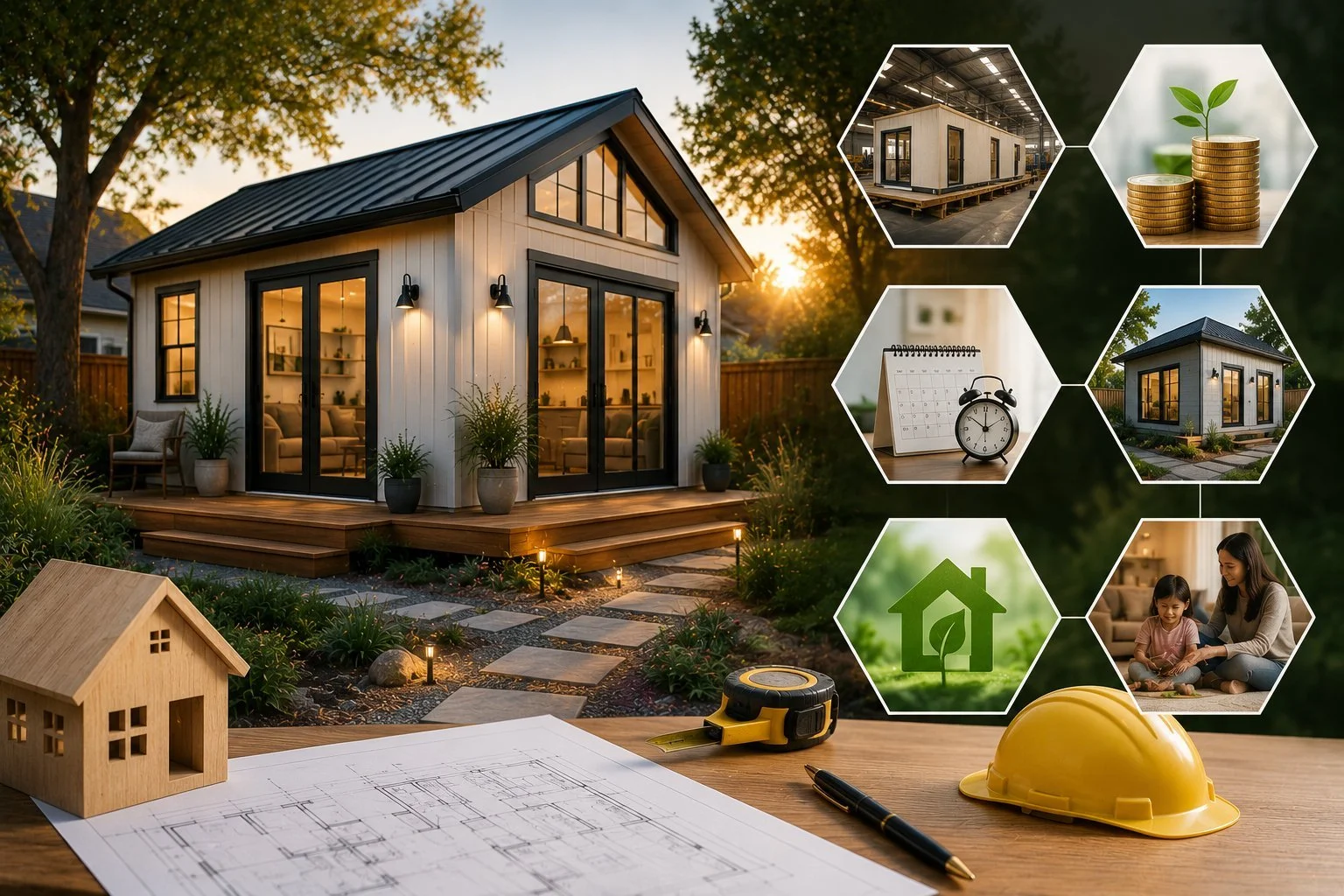
The smarter housing argument for prefab comes down to control. Site built construction puts the buyer at the mercy of weather, subcontractors, supply chains, and inspections that they cannot control. Prefab construction puts most of those variables in a controlled environment where the builder can manage them. The buyer gets a more predictable result with less risk.
Predictability has real value. It lets families plan around the new home rather than waiting on it. It lets buyers budget realistically without worrying about cost overruns. It lets households move forward with confidence rather than anxiety about whether the project will actually deliver.
If you are ready to see what prefab actually looks like at real pricing and floor plan detail, you can view prefab ADU models available now and start narrowing your shortlist. Walking through real models is the fastest way to know whether the category fits your property and your situation.
Comparing prefab to other small home options
Prefab ADUs sit in a category that overlaps with several adjacent options. Modular homes are factory built and assembled on a foundation but are usually larger than a typical prefab ADU. Manufactured homes are built to HUD code and can serve as ADUs when placed on a residential lot. Tiny homes on wheels are mobile by design but vary widely in build quality. Site built tiny homes are essentially custom construction at a small scale.
For most California and Oregon homeowners adding an ADU, the factory built prefab category offers the best balance of cost, timeline, and quality. The structure is real and durable. The factory build keeps quality consistent. The timeline is short enough to plan around. The financing path is established. The resulting home looks and lives like a small custom house.
How buyers evaluate prefab options
Buyers evaluating prefab ADU options usually look at three areas. The first is the floor plan and the layout. Does the home work for the intended use case. Is there enough storage. Does the bathroom and kitchen accommodate daily use. Are the windows placed well for light and privacy.
The second is the construction and finish quality. What standards is the home built to. What materials are used. How does the manufacturer handle quality assurance. What does the warranty cover and for how long.
The third is the total project cost. Not just the home, but delivery, set, anchoring, site prep, utility connections, permitting, and any add-ons. A clear, itemized quote makes this comparison much easier than a vague headline number.
Buyers who run through these three areas systematically tend to make confident decisions. Buyers who skip one or two often find themselves surprised at the end.