
ADU Construction in California: The Full Process from Start to Finish

ADU construction in California follows a clear path when you know the steps. Most homeowners do not because they have never built one before. The process feels confusing from the outside, with permits, contractors, factories, financing, deliveries, and inspections all happening at different times. Once you understand the sequence, the whole thing becomes manageable, and the decisions become easier to make in the right order.
This guide walks through the full process from initial planning to the day you move into the unit. It covers planning and site review, choosing a model, permits and approvals, the factory build phase, and delivery and final placement. The goal is to give you a clear map so you know what to expect at every stage.
Planning and site review
Every successful ADU construction project in California starts with planning. The first step is understanding what you actually need from the unit. A home for an aging parent has different requirements than a guest house, a rental unit, or a primary residence for a downsizer. Writing down who will use the home and how lets the rest of the planning flow from there.
The second step is a site review on your property. Walk the lot with placement in mind. Note where the unit could go, what the setback rules in your jurisdiction allow, how the delivery truck would reach the spot, and where the utility connections are. A simple sketch of the lot with placement marked is enough to start. A more detailed survey may come later if needed.
The third step is a budget conversation with yourself or your partner. How much is realistic to spend on the home, on site prep, on financing costs, and on any add-ons. Without a budget range in mind, the model conversation goes nowhere.
The fourth step is reaching out to a builder. A short consultation with a builder who knows the California market will narrow the options quickly and give you a realistic sense of timeline and cost. Tiny Home Cottages handles this conversation regularly with buyers across California and can walk you through how the lineup fits different lots and use cases.
Choosing a model
Model selection follows planning. With the use case clear and the lot understood, the model choice becomes much easier. Tiny Home Cottages offers single story tiny homes, premium single story models, lofted models, cabin series cottages, and HUD manufactured homes. Each fits different combinations of lot, use case, and budget.
Single story tiny homes work well for accessibility and full time daily use. The interior feels open with approximately nine foot ceilings throughout. Premium single story models add upgraded features and cement exterior siding for a more refined finish. Lofted models pack more usable space into a smaller footprint with a second level loft. Cabin series cottages bring tongue and groove pine walls and ceilings, metal roofing, and fiber cement siding for a warmer, more rustic look. HUD manufactured homes deliver more square footage when the lot supports the size.
The right model usually emerges from a short conversation about the lot, the use case, and the budget. Two or three models tend to surface as the best fits. Walking through real floor plans and finish levels narrows the final decision.
Permits and approvals
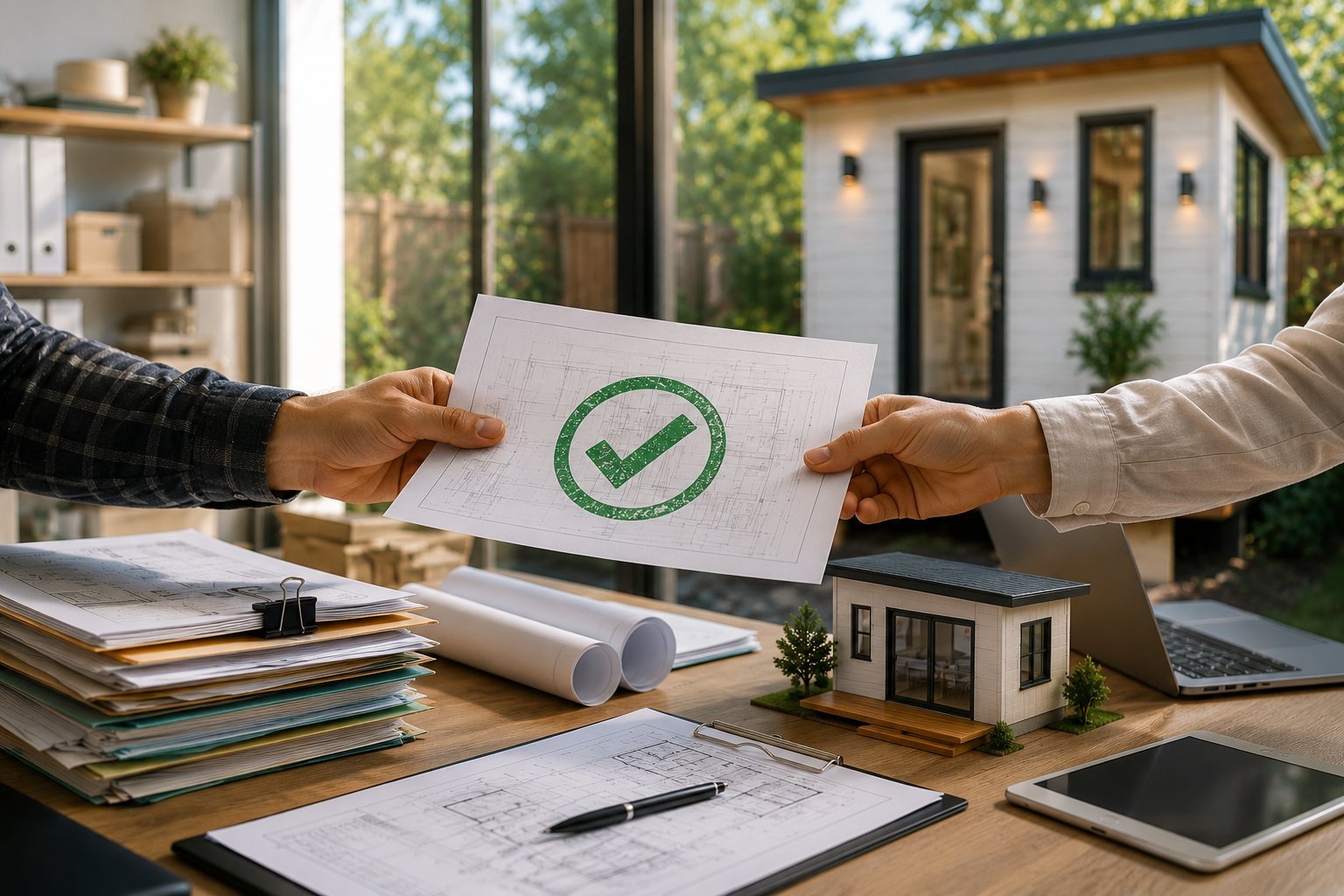
California has worked over the past several years to make ADU permitting more predictable. Local jurisdictions still vary in their specific rules, but the overall pattern is consistent. Most permits cover the placement of the unit on the lot, the connection to utilities, and the site preparation work. The factory built unit itself is constructed to applicable code standards before it arrives, which simplifies the inspection process on your end.
The permit work typically requires a few documents. A site plan showing the placement of the unit, the setbacks, and the access from the street. Specifications on the home itself, which the builder provides. Utility connection details. Any required structural or electrical drawings depending on the local jurisdiction. A builder who has delivered units in California can usually walk you through the documents and the process.
Permit timelines vary. Some jurisdictions have streamlined ADU approval processes that move quickly. Others take longer. Starting the permit process early, while the model selection and financing are being finalized, keeps the overall timeline moving.
Factory build phase
The factory build phase is where the home is actually constructed. Once your order is placed and the production schedule is set, the manufacturer begins the build. The home is constructed indoors on a controlled schedule using consistent crews, controlled materials, and continuous inspection.
The build follows a standard sequence. The floor system is constructed first. Walls are framed and stood. The roof is built. Exterior sheathing and weatherproofing go on. Windows and doors are installed. Insulation is added. Drywall and interior finishes go in. Cabinets, plumbing fixtures, electrical fixtures, and appliances are installed. Final finishes complete the home.
Inspections happen at every stage. The factory environment keeps quality consistent because the same crews use the same materials and the same processes every day. Tiny Home Cottages partners with manufacturers that have decades of experience producing small homes and cottage style dwellings. That experience shows up in the finished product.
While the factory build runs, site prep happens in parallel on your property. The pad gets built, utility stub-outs go in, and any local permitting wraps up. The two streams converge at delivery, which is the next major milestone.
Delivery and final placement
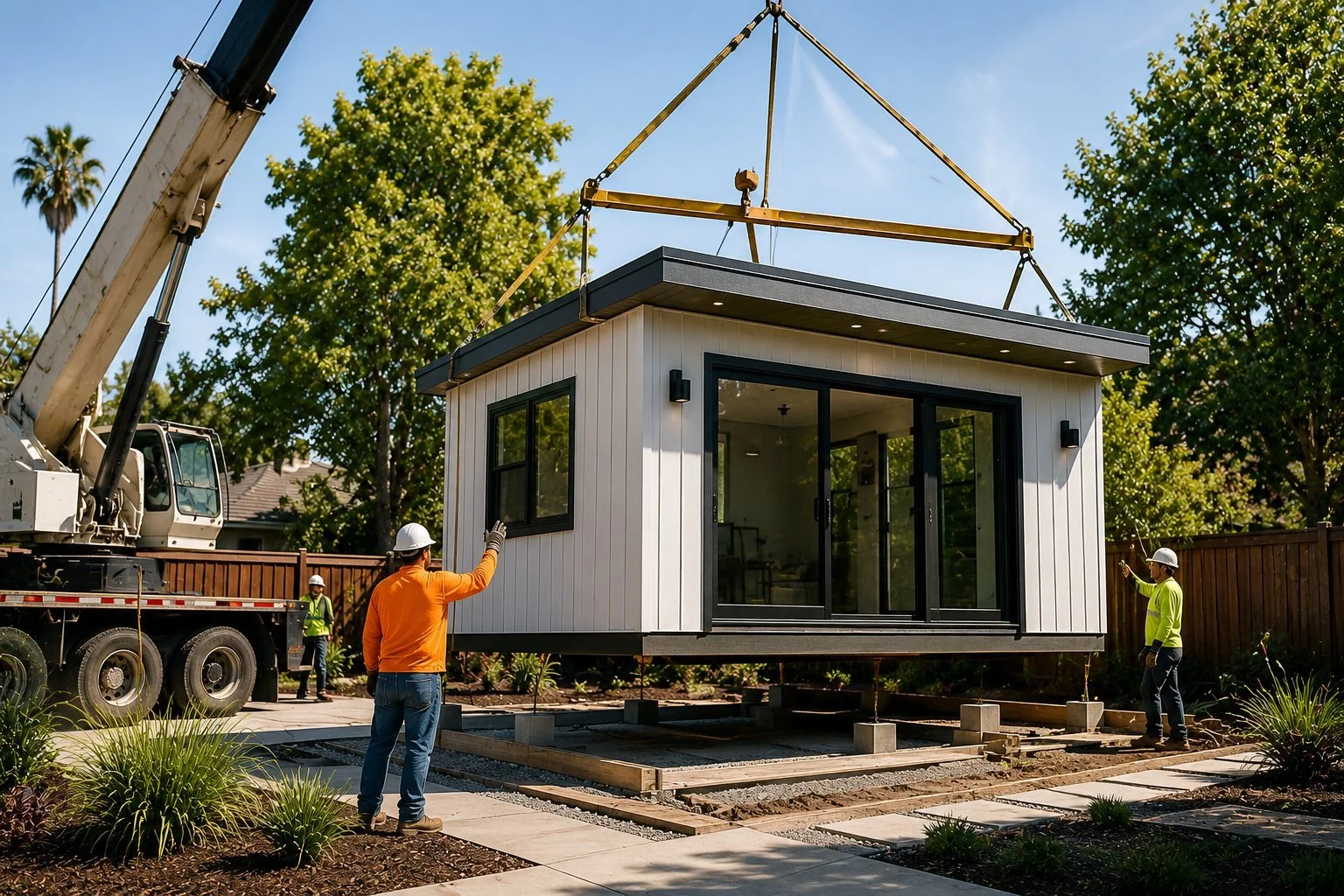
Delivery and final placement are the visible end of the construction process. Once the factory build is complete, the home is loaded onto a truck and trailer, secured for transport, and driven to your property. Depending on the size of the home and the access on your lot, the delivery crew uses a truck, trailer, and sometimes a crane to position the home on the prepared pad.
The set process usually takes hours for a smaller tiny home and longer for a larger HUD manufactured home. The crew levels the home, anchors it, and makes the basic connections to utilities. Final inspections happen as needed depending on local requirements. Once the inspections clear, the home is ready for occupancy.
For most California homeowners, the time from initial inquiry to move-in is far shorter than a site built project. The factory build, the parallel site prep, and the coordinated delivery all happen on known schedules. Compared to a site built ADU that can stretch over a year, the factory built path delivers in a much tighter window with much less uncertainty along the way.
## Financing through 21st Mortgage
Most buyers finance the purchase. Tiny Home Cottages often recommends 21st Mortgage Corporation, which specializes in manufactured and mobile home loans. Down payment options range from zero percent for highly qualified buyers to higher percentages depending on credit profile and property conditions.
The application moves through a clear sequence. Pick the home model that fits your needs and budget. Complete the application with the lender. Receive loan approval and review the financing terms. Lock the interest rate and submit required documentation including identification, income verification, and bank statements. Sign closing documents and finalize the loan. Funds are distributed and the purchase moves to delivery scheduling.
Starting the financing conversation early in the planning phase keeps the budget realistic and the timeline accurate. Pre-qualifying gives you a real ceiling on your search.
What to expect at each stage
The buyers who have the best experience know what to expect at each stage. The planning phase takes weeks. The model selection and financing approval take additional weeks. The factory build phase runs on a defined schedule depending on the model and production queue. Site prep happens in parallel. Delivery is a single day event after the factory build wraps. Final inspections and connection wrap shortly after delivery.
If you want to see how the process plays out in practice and the typical sequence for a California ADU, you can read the step-by-step ADU build process for the detailed breakdown. That walkthrough gives you a clear sense of what to expect at every milestone, from initial inquiry to the day you move into the unit.
Timeline expectations by phase
Knowing how long each phase takes helps homeowners plan around the project. Initial planning and site review usually take one to two weeks of casual work and conversation. Model selection and the financing pre-qualification often happen in parallel and take another two to four weeks depending on how quickly documentation comes together.
The permit phase varies more widely. Some California jurisdictions move quickly on factory built ADU permits. Others take longer. Starting the permit process early in the project keeps the overall timeline tight. A builder familiar with your jurisdiction usually has a realistic sense of how long permits typically take.
The factory build phase runs on a defined production schedule that depends on the manufacturer's queue and the specific model. Tiny Home Cottages provides a realistic factory build window once an order is placed. Site prep happens during this window so the two streams converge at delivery.
Delivery is a single day event in most cases. Final inspections and any remaining utility connection work usually wrap within a few days to a few weeks after delivery depending on local requirements.
Common questions about the process
Buyers commonly ask whether they need a general contractor for a factory built ADU project. The answer depends on the scope. Tiny Home Cottages handles the home itself including delivery and set. Site prep, utility extensions, and any permit coordination usually involve a local contractor or the homeowner directly. A clear conversation upfront about who handles what makes the project run smoothly.
Another common question is how much homeowner involvement is required. Most homeowners stay involved during planning, model selection, and site prep coordination. During the factory build phase, the homeowner can step back because the work happens off-site. At delivery, the homeowner is usually present to confirm placement and review the home as it is set.
Why the process works
The factory built ADU process works because it controls the variables that drive project failure on site built projects. Weather does not stop the factory build. Subcontractor scheduling does not delay it. Material price swings during construction do not blow the budget. The home arrives on the agreed schedule, at the agreed price, with the agreed features. That predictability is what makes the category reliable for California homeowners.